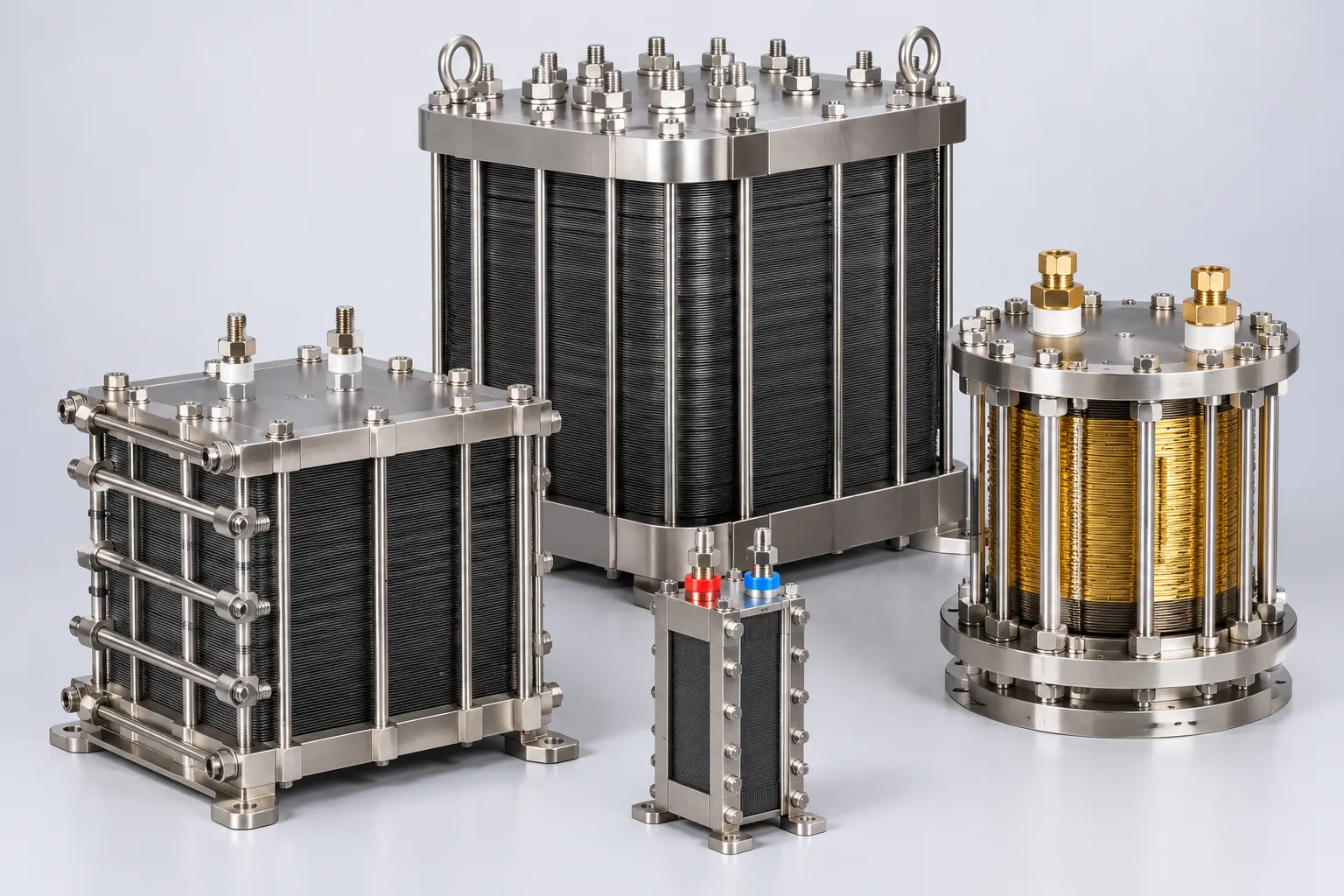
We supply PEM hydrogen generators for laboratories, analytical instruments, fuel cell test rigs and OEM product lines. The machine makes the gas on site, so there is no delivery schedule, no stored compressed gas and no interruption when a cylinder runs out at the wrong moment. What it does introduce is a specification of its own: the gas at your instrument has to meet a purity, an oxygen limit, a dew point and a pressure stability, and the machine has to be able to hold them.
Engineering boundary: an on-site generator is not automatically the better answer. It earns its place where the gas is consumed continuously, where cylinder deliveries interrupt the work, or where stored compressed gas is a safety or regulatory burden. For occasional use, for an instrument with its own buffering, or where no demineralised water is available, a cylinder is simpler and cheaper — and we will tell you so rather than supply a machine that is not the right instrument. The other boundary is that the gas specification belongs to the downstream process, not to the generator: state the instrument and the method, and the machine follows from that.
> 99.99 %Typical purity at the outlet, after purification
At the outletWhere every gas figure is measured and quoted
Dew point statedMoisture control, not assumed
Stack as consumableLife and replacement quoted with the basis
What This Machine Is
A Hydrogen Generator Is a Gas Supply With a Delivery Point Attached
A PEM hydrogen generator makes hydrogen on site, continuously, from demineralised water and electricity. For a laboratory or an OEM it replaces the cylinder: no deliveries, no storage of a compressed gas, no interruption when the delivery is late. In exchange it introduces its own set of obligations, and the ones that matter are the purity of the gas at the point of use, the behaviour of the machine when the load changes, and the maintenance of the stack.
The chemistry is the same as it is for a large plant, and the engineering is not. A laboratory generator runs at a few hundred watts, produces a few tens of millilitres per minute, and feeds an instrument that draws a steady trickle. There is no load-following to speak of and no grid interface. What there is instead is a very tight requirement on the gas, because the downstream instrument was specified against a particular purity, a particular pressure and a particular flow, and any deviation shows up as an analytical result that has to be explained.
That is why the specification of a laboratory generator is mostly a specification of the gas. Purity, the oxygen content, the moisture content and the stability of the flow are the four figures that decide whether the instrument runs cleanly. The machine is chosen to deliver them, and the packaging — the drying, the purification, the pressure regulation and the outlet fitting — is where most of that work is done.
The other thing a generator brings is a stack with a life. It is a consumable, it is replaced at some point, and the cost of that replacement should be visible in the quotation rather than discovered in the third year. We state the basis on which the life was assessed and the cost at which it can be replaced.
01
The gas is the product
Everything else on the machine exists to deliver a gas with a defined purity, pressure and flow at the outlet. That is the acceptance criterion, not the output of the cell.
02
Pressure regulation is part of the machine
A cell produces gas at a pressure that varies with load and temperature. The regulator, the buffer and the relief arrangement are what turn that into a stable delivery.
03
The stack is a consumable
It has a life measured in operating hours, and replacing it is routine. The replacement cost and the interval belong in the commercial offer.
04
The feed water sets the interval
Demineralised water with the metal ions removed. Poor feed water shortens the stack, and the water treatment is what protects the investment.
Purity And What It Means
What 99.99 % Actually Covers, and What It Does Not
Purity is quoted as a single number, and it is the single most useful and most misused figure in this field. A purity statement has to name what is excluded and where it is measured, because the answer that matters is the one at the instrument, not at the stack.
Specification
What it states
Where it has to be measured
Hydrogen purity
The proportion of hydrogen in the gas, with the balance being air or the residual oxygen and water from the cell
At the delivery outlet, after the purification stage, not at the cell
Oxygen content
The oxidising species that matters to the downstream process, whether it arrives as oxygen or as water
At the outlet, and it is the figure that determines whether the gas is fit for the carrier gas duty
Dew point
The moisture content, expressed as the temperature at which water starts to condense out
At the outlet after the dryer, and it is the figure that decides whether the gas can be used with a sensitive instrument
Pressure stability
How much the delivery pressure moves with the load and with the temperature of the cell
At the outlet over a load cycle, not at a single operating point
Flow stability
How much the delivered flow moves over the run
At the outlet, and it is what the instrument at the far end actually experiences
Start-up time
The time from power-on to gas at the stated purity
With the machine cold, because a warm start is much shorter
The numbers above are the reference windows we quote for a laboratory PEM generator. They are confirmed against your instrument and its method before they become a quotation, because an instrument that needs 99.99 % nitrogen as a carrier gas and one that needs a specific oxygen limit are not the same requirement.
Purity is a specification against a use, not a grade of gas
This is worth saying plainly, because a purity figure quoted without a use invites a mismatch that only appears after the instrument is installed.
The requirement for a gas chromatograph carrier, for a mass spectrometer, for a fuel-cell test rig and for a semiconductor process are four different requirements. We would rather be told which instrument the gas is going into than be told a purity number, because the second one tells us how to check the first.
Technical Data
The Parameters We Quote Against, and the Window Each One Belongs To
These are the reference windows for a laboratory PEM hydrogen generator. Each holds inside a stated condition and several of them pull against each other — the pressure configuration and the flow, the purity and the output. The quotation states the operating point, so the numbers have a meaning.
Technology
Proton exchange membrane, with the membrane grade stated
Feed
Demineralised water, with the conductivity limit stated
Hydrogen output
Typically tens of millilitres per minute in the laboratory range
Hydrogen purity
Typically better than 99.99 % at the outlet, after purification
Oxygen content
Quoted with the load, because crossover rises with current density
Dew point
Set by the dryer stage, quoted at the outlet
Delivery pressure
Configurations from near atmospheric to several tens of bar
Pressure stability
Quoted over a load cycle, not at one operating point
Start-up time
From cold, to gas at the stated purity
Stack life
A function of the operating hours and the feed quality; quoted with the basis
Power supply
Stated input, and the connection requirements are part of the delivery
Outlet
The fitting and the interface to the instrument are specified with the order
The delivery point is part of the specification
A frequent source of a late problem, and a cheap one to avoid.
The outlet fitting, the tubing, the regulator position and the distance to the instrument all affect the gas the instrument actually receives. A tube of the wrong material or a fitting left as a leak path can undo a purification stage that was specified correctly. We agree the interface with you rather than leaving it to the installer.
Behaviour Over Time
Start-Up, Transients And What Happens When the Load Moves
A laboratory instrument does not take a constant flow. It takes what it needs, it stops and starts, and it may be left idle for a weekend. The behaviour of the generator through those transitions is what determines whether the analytical results stay comparable, and it is the part of the specification that is usually left out.
A PEM stack responds quickly, which is an advantage when the load follows a test schedule and a disadvantage when purity has to settle before a reading is taken. After a change in load the gas composition moves for a period, and if a reading is taken during that period it will not be comparable with one taken in steady state. The machine can be controlled to make that settling period short and known, and the correct way to do it is a control strategy rather than a delay in the operator instructions.
The second behaviour that matters is idle. A stack that is switched off for a long period does not come back the way it left. The membrane is exposed to whatever is on the cathode side during the stoppage, and the water in the cell can sit against surfaces that were wetted under load. The recovery time after a long stop is longer than after a short one, and a machine that is used every day behaves differently from one that runs intermittently. If the duty is intermittent, say so, because the recovery behaviour has to be designed for it.
The third is the drift over a long run. The cell output falls slightly as the stack ages, and the purification stage has a finite capacity before it needs attention. Both are gradual and both are manageable, provided the instrument is fed from a stable reference and the maintenance interval is set from the operating hours rather than from the calendar.
1
Cold start
From power-on to gas at the stated purity. This is the figure to compare against an instrument method that has a defined ready time.
2
Load change
How fast the delivery follows a change in the drawn flow, and how long the gas takes to settle back to the stated purity.
3
Extended shutdown
How the machine behaves after it has been off for days or weeks, and how long it takes to be back in specification afterwards.
4
Stack ageing
The gradual change in output over the life of the stack, and how the maintenance interval is set from the operating hours.
5
Purifier duty
The capacity of the purification stage between services, and the indication that the service is due.
Where The Gas Is Used
The Laboratory Duties, and the One Case Where a Cylinder Is Better
An on-site generator earns its place where the gas is consumed continuously, where the delivery of cylinders interrupts the work, or where the stored gas on site is a safety or regulatory burden. It does not earn its place where the gas is used occasionally, and we say that when it applies.
01
Analytical instruments
Carrier and make-up gas for gas chromatography, mass spectrometry and ICP instruments, where a continuous supply avoids the interruption of a scheduled delivery and the contamination risk of a shared cylinder.
02
Fuel cell and electrolyser testing
A controllable hydrogen source with a known purity and a known pressure, including the transient behaviour the test programme depends on.
03
Semiconductor and thin-film processes
Process atmospheres that need a stable, clean hydrogen delivered at a defined pressure and flow, in small volume and without the logistics of a gas supplier.
04
Chemical vapour deposition
Hydrogen as a carrier or reducing gas in deposition equipment, where the delivery has to be steady and the purity consistent from one run to the next.
05
OEM integration
The generator built into a customer instrument or a customer product line, where the module, its interface and its service access are defined by the customer rather than by the laboratory.
06
Where a cylinder is the better answer
If the gas is used in short bursts, if the instrument has its own gas purification and buffering, or if the laboratory has no demineralised water available, a cylinder is simpler and cheaper. We would rather supply one of these than sell a machine that is not the right instrument.
The Product Family
Compact Units, OEM Modules And Custom Machines
Three delivery forms, distinguished by where the machine sits in your organisation rather than by a performance ladder.
01
S-Series compact
Bench and floor-standing PEM generators for laboratory supply, with a range of pressure configurations and the outlet interface agreed with the instrument.
02
OEM modules
Generators built as modules for integration into a customer enclosure or a customer product, with the electrical, control and gas interface defined by the OEM.
03
Custom configurations
Machines built to a duty that the standard range does not cover: a specific output, a specific purity, a specific footprint or a specific interface.
Inside The Factory
How the Assembly, the Gas Path and the Records Are Controlled
A generator that has to sit on a laboratory bench for years has to be built to a standard that the person who assembled it will never see. The inspection below covers the parts that decide whether the gas that comes out is the gas that was specified.
1
Cell and materials
The membrane assembly materials, the catalyst and the gasket set are confirmed against the specification and recorded against the serial number.
2
Gas path integrity
The cell, the purification stage, the dryer and the regulator are pressure and leak tested as a path, because a leak anywhere in it defeats the whole package.
3
Functional running
The unit is run and the output, the purity, the oxygen content and the pressure behaviour at the outlet are measured.
4
Interface and documentation
The outlet fitting, the electrical connection and the control interface are checked as delivered, and the document package is assembled to the agreed scope.
5
Packing and traceability
The machine is packed for transport and for installation, and the delivery is tied back to the production record by its serial number.
Custom Engineering
A Hydrogen Generator Specified Against Your Instrument, Not Against a Purity Number
The output, the purity, the pressure, the dew point, the outlet interface and the delivery form are reviewed together against the instrument that will consume the gas. What comes back is a machine with a stated gas specification at the delivery point, not a generator with a purity label on the front.
Define the Instrument, the Flow and the Delivery Point Before Quotation
“Hydrogen generator” is a starting point, not a specification. The gas at the outlet, the interface to the instrument and the acceptance of the machine are only reviewable once the use, the flow and the interface are stated.
What we review before manufacture
State which instrument or process the gas serves, and the method it has to satisfy.
State the flow required and the duty cycle, including whether the machine runs continuously.
State the purity and the oxygen content the process needs.
State the dew point requirement, or the humidity the instrument is sensitive to.
State the delivery pressure and how stable it has to be at the outlet.
State the outlet fitting, the tubing route and the distance to the instrument.
State the demineralised water available at site and the utilities the machine can use.
State the acceptance criteria and the document scope you need at delivery.
What the product name cannot replace
A purity figure without a stated use does not say whether the gas suits the instrument.
A flow figure without a duty cycle does not say whether the machine will be idle for long periods.
A start-up time measured warm says nothing about the cold start that matters on a Monday.
The demineralised water plant and the laboratory gas installation are assigned by the project.
Where our supply boundary sits
We supply the generator, the gas handling, the control package and the documentation. The electrical supply, the demineralised water plant, the laboratory gas installation downstream of the outlet, the ventilation and the permits are assigned by the project. For an OEM module the boundary is defined by the interface documents you issue.
Related pages
Compare the adjacent pages once the duty and the delivery boundary are clear.
FREQUENTLY ASKED QUESTIONS
PEM Hydrogen Generator FAQs
The questions asked before a laboratory hydrogen generator is specified, answered with the reasoning rather than with a feature list.
How is this different from buying hydrogen cylinders?
A cylinder is a stored gas that has to be delivered, stored, handled and replaced, and it interrupts the work when it runs out. A generator produces the gas on site from water and electricity, so the supply is continuous and there is no compressed gas on site. The cost of that is the capital of the machine, the electricity, the demineralised water and the stack that has to be replaced at some point. For a continuous duty the generator usually wins on both cost and convenience; for occasional use the cylinder is normally the better answer.
What purity can you guarantee?
We quote the purity at the outlet, after the purification stage, and together with the load it is measured at, because oxygen crossover rises with current density. A figure in the high-purity range is typical for a laboratory PEM generator. We would rather quote it against your instrument and its method than against a headline number, because that is the figure you can actually check.
What happens if the machine is left switched off for a week?
Recovery after a long stop is slower than recovery after a short one, because the cell is exposed to a different condition while it is idle and the water in it sits against surfaces that were wetted under load. If the duty is intermittent, we design the control and the start-up sequence around that, and we state the cold start time in the specification. Tell us the duty pattern, because a machine used every day and a machine used in bursts are not the same specification.
Do you supply the demineralised water plant?
Not by default. We specify the feed water the machine needs and the consequence of not meeting it, and we can supply or specify the treatment. In most laboratory installations the site already has a suitable supply or a small unit is a straightforward addition, and it is normally the customer who owns that part of the system. It is stated in the boundary rather than left open.
Can you supply an OEM module?
Yes. We build generators as modules for integration into a customer enclosure or a customer product, with the electrical, control and gas interface defined by you. That work runs on the interface documents rather than on a duty description: the power, the signals, the outlet, the control setpoints, the service access and the acceptance requirements.
What testing is carried out before shipment?
The gas path is pressure and leak tested as a whole, and the machine is run with the output, the purity, the oxygen content and the pressure behaviour at the outlet measured. The acceptance criteria agreed at the order are applied, and the outlet interface and the electrical connection are checked as they are delivered.
What do you need from us to quote?
Which instrument or process the gas serves, the flow and the duty cycle, the purity and the oxygen content the process needs, the dew point requirement, the delivery pressure and how stable it must be, the outlet fitting and the tubing route, the demineralised water available at site, and the acceptance criteria and document scope. With that we answer with the configuration, the gas specification at the outlet and the document scope.
What is the dew point and why does it matter?
The dew point is the temperature at which water starts to condense out of the gas, and it is the way moisture content is stated. It matters because a wet gas can damage a sensitive instrument, upset a detector or condense in a capillary where it should not. The dryer stage of the generator sets it, and it is specified at the outlet rather than at the cell.
How long does the stack last?
It depends on the operating hours and on the feed water quality, and we quote it with the basis on which it was assessed so it can be checked against your own duty. The stack is a consumable and the replacement is routine; the replacement cost and the interval belong in the quotation rather than being discovered later. Good feed water and a sensible operating temperature are what protect the interval.
Can the generator follow a variable flow?
A PEM stack responds quickly, so it follows a changing draw better than the alternatives. What matters is what happens to the gas composition during the transition: it settles for a period, and a reading taken during that period is not comparable with one taken in steady state. We set the control strategy so the settling period is short and known, rather than leaving it to be discovered at the instrument.
Inside our factory
How the Assembly, the Gas Path and the Records Are Controlled
We control the cell materials, the assembly, the integrity of the gas path and the functional test against the approved order basis. The inspection records identify what was checked, the agreed method and the accepted result for the supplied machine.
1. Material Identity
Confirm the membrane assembly materials, the catalyst, the gasket set and the body materials against the specification, and record them against the serial number.
2. Assembly
Build the cell to the stated compression and the stated active area, and fit the purification and drying stages to the agreed configuration.
3. Gas Path Integrity
Pressure test and leak test the cell, the purifier, the dryer and the regulator as one path, and record the result before the machine is closed.
4. Functional Test
Run the machine and measure the output, the purity, the oxygen content and the pressure behaviour at the outlet.
5. Release and Traceability
Verify the interface, the identification, the visual condition, the packing and the document package, and tie the delivery back to the production record.
Sampling, acceptance values, test methods and the supplied records are finalised in the quotation, the inspection plan or the approved order documents.
Inspection scope is matched to the ordered machine and the agreed evidence package.
Application Review
Send the Instrument, the Flow and the Duty Cycle
A comparable quotation starts with the instrument the gas serves, the flow and the duty cycle, the purity and oxygen content the process needs, the dew point, the delivery pressure and the outlet interface. Give us those and we answer with the configuration, the gas specification at the delivery point and the document scope.
The instrument or process the gas serves, and the method it has to satisfy
The flow required and the duty cycle, including how often the machine is idle
The purity and the oxygen content the process needs
The dew point requirement and the humidity the instrument is sensitive to
The delivery pressure and how stable it has to be at the outlet
The outlet fitting, the tubing route and the distance to the instrument
The demineralised water and the utilities available at site
The acceptance criteria and the document scope at delivery